
May 11, 2021


← Back to The Cannabis Strain Encyclopedia
Part of the Cannabis Strain Encyclopedia, a series documenting the strains that shaped modern cannabis genetics.
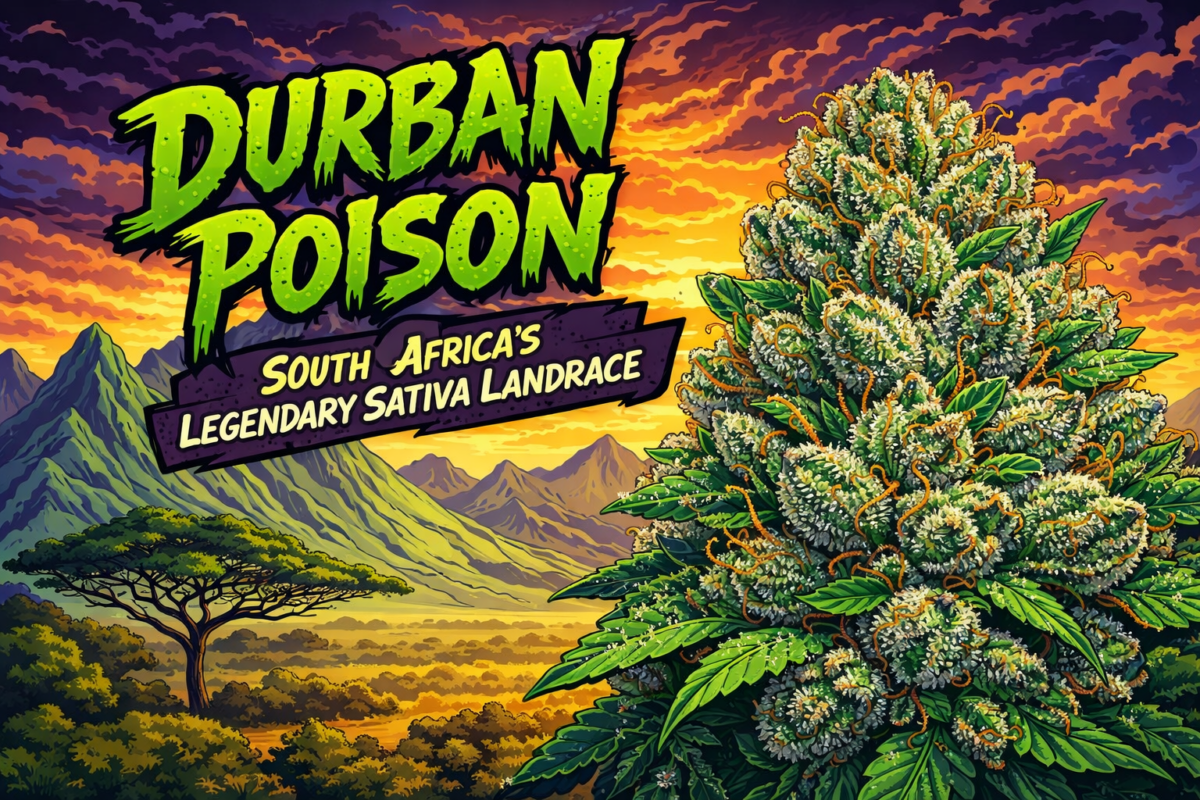
Long before modern breeding programs and dispensary menus turned cannabis into a catalog of branded names, the plant was evolving naturally across different parts of the world. In South Africa’s KwaZulu-Natal region, cannabis adapted to a warm climate and long growing season, producing the tall, vigorous structure that would later define Durban Poison. Durban, the major port city in the region, ultimately gave the strain its name as these genetics became known more widely.
Where mountain landraces such as Afghani and Hindu Kush became associated with dense, resin-heavy flowers, Durban Poison emerged as a classic equatorial-style sativa. Its structure reflects a different environment and a different branch of cannabis history, one rooted in sunlight, airflow, and seasonal expansion rather than compact hash plant morphology.
By the 1970s, breeders and collectors were actively gathering landrace genetics from traditional growing regions around the world, and Durban Poison became one of the most important African strains to enter that global conversation. Its value was not in behaving like an indica, but in preserving a very different set of traits: height, vigor, aromatic sharpness, and the kind of structure that reminded growers how wide the cannabis family tree really is.
Alongside Hindu Kush, Afghani, Thai, Colombian Gold, and Panama Red, Durban Poison helped form the landrace foundation behind modern cannabis breeding.
Durban genetics are also widely associated with the Durban side of the lineage behind Girl Scout Cookies, though descriptions vary between sources, with some referring specifically to Durban Poison and others to F1 Durban or “Durb.”
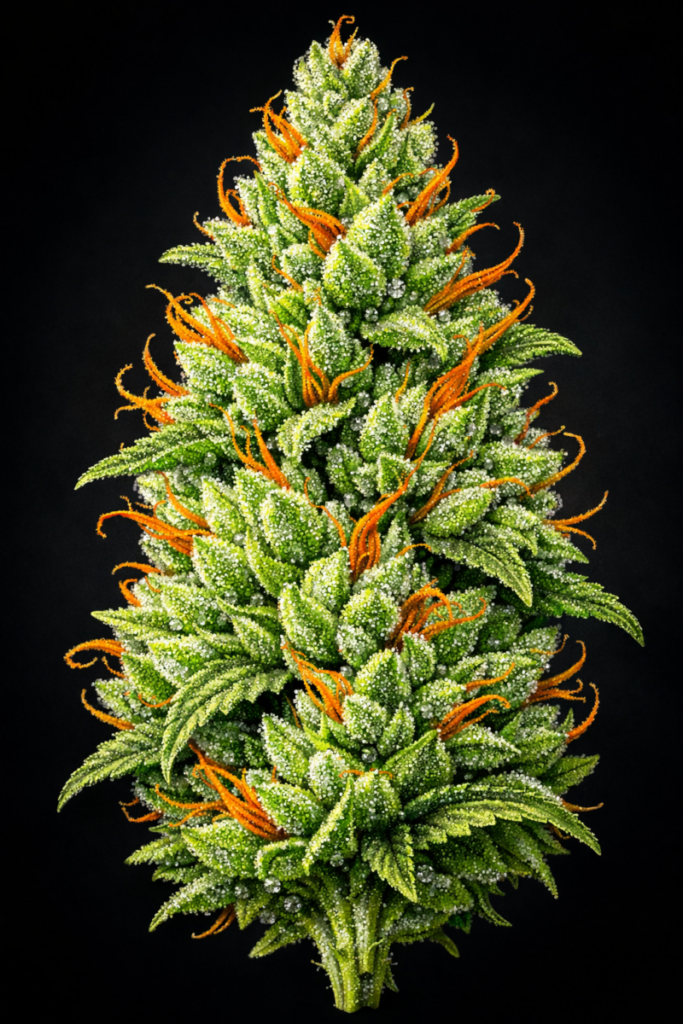
Durban Poison does not usually resemble the short, tightly packed buds associated with traditional indica landraces. Instead, it tends to express a longer, more open flower structure with lighter green coloration, visible trichomes, and bright orange pistils. That visual profile is part of what makes the strain so easy to distinguish in a landrace conversation.
Its morphology reflects the environment that shaped it. Rather than evolving for compact resin production in cold mountain regions, Durban Poison developed in a setting that favored stretch, movement, and a more elongated floral structure.
Durban Poison is widely known for a bright, spicy, herbal aroma that often carries notes of anise, pine, citrus, and sweet earth. Many modern descriptions of the strain point to terpinolene as a defining part of that profile, helping explain why Durban Poison smells so different from the dessert, gas, and candy-heavy strains that dominate today’s market.
That distinct expression is part of the strain’s staying power. Durban Poison never needed to smell like frosting to earn respect. It already had its own voice.
As a landrace strain, Durban Poison remains important because it preserves a recognizable example of African cannabis genetics within the modern market. It gives growers and breeders a reference point for traits that were shaped by region, climate, and long-term local cultivation rather than by contemporary commercial hybridization.
That matters because landraces are the root system of cannabis history. Without them, modern breeding loses context. Durban Poison helps preserve that context by showing what a stable, regionally adapted sativa can look and smell like when it carries a strong historical identity.
Durban Poison represents one of the clearest African contributions to the global cannabis story. Long before cannabis became a branded retail category, communities across South Africa were cultivating plants suited to local conditions. Those traditions helped preserve the diversity that later breeders would depend on.
In that sense, Durban Poison is not just a strain name. It is part of the historical record of how cannabis moved across continents, adapted to local environments, and eventually entered modern culture carrying the memory of where it came from.
Even in an era of boutique genetics, Durban Poison still matters because it reminds the modern cannabis world that not every influential strain began as a hype cross. Some of the most important cannabis genetics were shaped over generations by geography, climate, and cultivation traditions.
For historians, breeders, and serious cannabis enthusiasts, Durban Poison remains one of the most important landrace strains ever brought into the modern genetic conversation.
Continue exploring the foundations of cannabis genetics.
