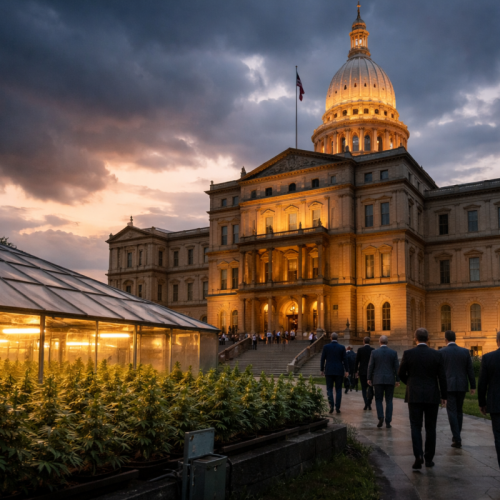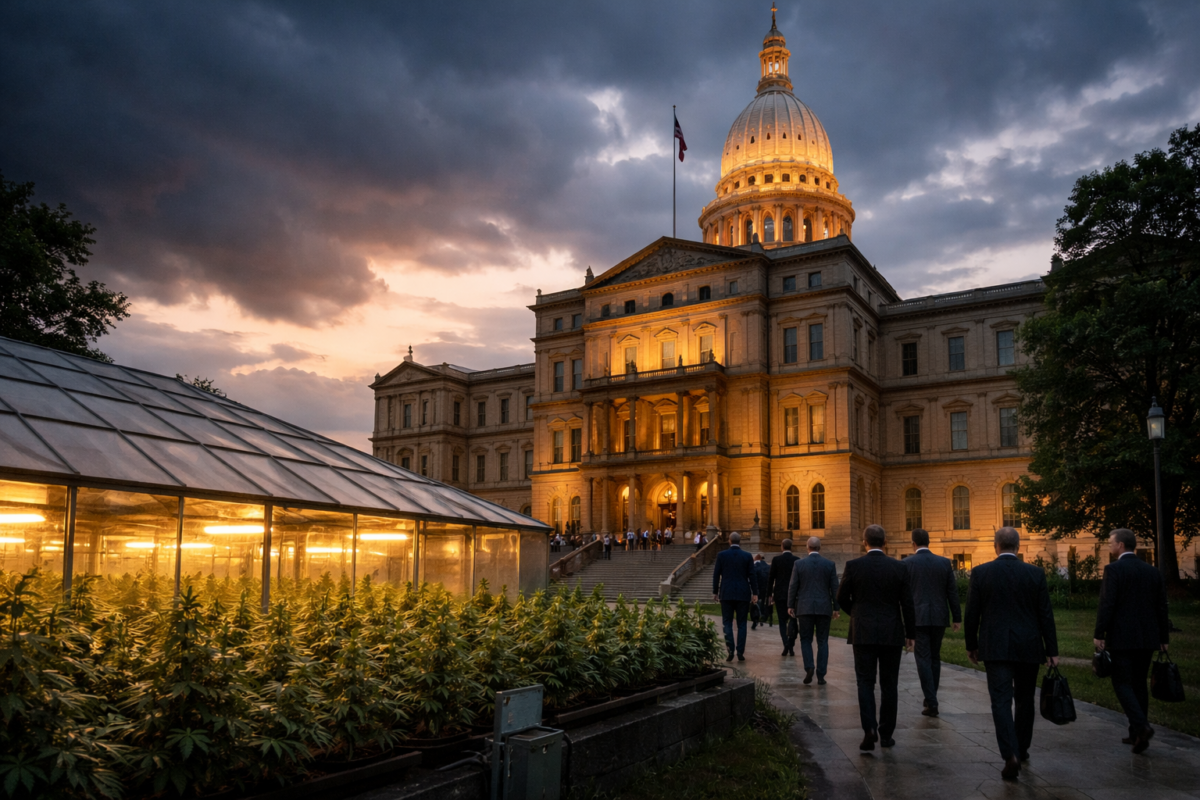
Michigan’s cannabis industry is already feeling the shockwaves of a controversial new tax. Now lawmakers are trying to undo it before more damage spreads.
A bipartisan group of Michigan senators has introduced legislation to repeal the state’s newly enacted 24% wholesale marijuana tax. The proposal arrives just months after the tax quietly became law as part of a larger road funding package.
Supporters of the repeal say the policy threatens licensed cannabis businesses and may unintentionally strengthen the illicit market. However, reversing the tax will not be easy. Legislators must now weigh industry concerns against a massive hole in the state budget.
Bipartisan Effort to Repeal Michigan Marijuana Tax
The repeal effort is moving forward under Senate Bill 810, sponsored by Republican state Sen. Jonathon Lindsey of Coldwater.
The bill has drawn support from a bipartisan coalition that includes five Republican senators and three Democrats. Their goal is simple: eliminate the new wholesale tax before it destabilizes the legal cannabis market.
Democratic Sen. Jeff Irwin of Ann Arbor, a longtime cannabis policy advocate, acknowledged that reversing the tax will face political resistance.
According to Irwin, many lawmakers are beginning to reconsider the policy as the consequences emerge.
Businesses are closing. Jobs are disappearing. Meanwhile, state revenue projections tied to cannabis sales are already falling short.
Irwin believes those realities could eventually shift votes.
Cannabis Sales Already Showing Signs of Decline
Early market data is raising concerns across Michigan’s legal cannabis sector.
According to figures released by the state’s Cannabis Regulatory Agency, January marijuana sales totaled $226 million. That marks the lowest monthly sales figure since February 2023.
For context, Michigan’s cannabis market averaged $264 million per month over the previous year.
While analysts cannot definitively link the decline to the new tax yet, industry leaders believe the connection will become clearer over time.
Irwin noted that Michigan’s cannabis market relies heavily on out-of-state customers. Visitors from neighboring states frequently cross into Michigan to purchase legal cannabis.
Higher wholesale costs could push retail prices upward, which may drive those customers elsewhere.
How the 24% Cannabis Tax Became Law
The controversial tax did not originally appear in the legislation that created it.
Michigan lawmakers introduced the measure under the Comprehensive Road Funding Tax Act, a large infrastructure bill designed to generate funding for state road repairs.
The bill, House Bill 4951, initially contained no mention of marijuana taxes.
However, lawmakers inserted the cannabis tax language into a substitute version of the bill on September 25, the same day the Michigan House voted to pass it by a 78-21 margin.
Critics argue the change happened too quickly for industry stakeholders to respond.
Karen O’Keefe, director of state policies at the Marijuana Policy Project, believes lawmakers rushed the legislation to avoid organized opposition.
The Michigan Constitution requires a waiting period when substantial changes are made to legislation. Opponents say that rule was bypassed.
However, courts have so far rejected that argument.
Legal Challenge Still Moving Through Courts
Michigan’s cannabis industry is fighting the tax in court as well.
The Michigan Cannabis Industry Association, the state’s largest marijuana trade group, filed a lawsuit challenging the tax shortly after it passed.
Their argument centers on Michigan’s voter-approved marijuana legalization law from 2018.
That ballot initiative established a 10% cannabis excise tax. Under the state constitution, lawmakers must secure a three-fourths majority to modify voter-approved laws.
Industry lawyers argued that the new wholesale tax effectively changed that structure and therefore required a supermajority vote.
Michigan Court of Appeals Judge Sima G. Patel dismissed that claim in January.
The judge ruled the new tax did not technically alter the voter-approved tax rate. Therefore, the supermajority requirement did not apply.
However, Patel allowed the broader lawsuit to continue.
She wrote that the wholesale tax could still conflict with the original intent of Michigan’s legalization law.
One goal of legalization was reducing the illicit marijuana market. Patel noted that higher taxes could potentially push consumers back toward illegal sellers.
A court conference on the case took place in February, and the lawsuit remains ongoing.
Industry Fears Black Market Growth
For many cannabis operators, the tax raises an existential question: can legal businesses survive under the new cost structure?
Wholesale cannabis taxes increase costs at the earliest stage of the supply chain. Those costs eventually reach retailers and consumers.
If prices rise too sharply, consumers may turn to illegal sellers who avoid taxes altogether.
O’Keefe said she recently spoke with a licensed cultivator who invested their entire life savings into a cannabis business.
That entrepreneur fears the new tax could make the operation financially impossible.
If legitimate operators leave the legal market, illegal sales could quickly fill the gap.
Budget Reality Complicates Repeal
Even lawmakers who dislike the tax face a difficult dilemma.
State budget analysts estimate the marijuana tax could generate $420 million for Michigan’s road funding plan. The overall infrastructure package totals roughly $1.8 billion.
If lawmakers repeal the cannabis tax, the state must find alternative funding.
Sen. Irwin acknowledged the projections may have been overly optimistic.
Still, eliminating the tax could leave a massive gap in the current budget.
Some lawmakers admitted they reluctantly supported the measure during last year’s negotiations.
Republican Rep. Joseph Aragona said at the time that the tax was part of a political compromise necessary to pass the broader funding package.
Why the Michigan Marijuana Tax Matters for the Industry
Michigan has become one of the largest cannabis markets in the United States.
The state consistently ranks among the top markets for total cannabis sales. It also attracts buyers from surrounding states where marijuana remains illegal or more expensive.
However, the industry operates on thin margins.
Wholesale prices have already dropped dramatically due to oversupply. Many cultivators are struggling to remain profitable.
A 24% wholesale tax adds another financial burden to an industry already navigating intense price competition.
If lawmakers fail to repeal the tax, Michigan could see several outcomes:
• increased business closures
• layoffs across cultivation and retail operations
• reduced legal cannabis sales
• stronger illicit market activity
For now, Senate Bill 810 represents the industry’s best chance to reverse course.
But the political path forward remains uncertain.
As lawmakers debate the repeal, Michigan’s cannabis operators are watching closely. Their future may depend on the outcome.
Black Cannabis Magazine is your go-to platform for cannabis culture, news, and lifestyle content with a focus on diversity and inclusion. For more information, visit www.blackcannabismagazine.com.
Copyright 2026 Black Cannabis Magazine. Distributed by Hazey Taughtme, LLC.